
This beginner’s guide introduces Islamic prayer, offering clear, step-by-step instructions. Learn how to pray with confidence and deepen your spiritual connection. Download our free, easy-to-follow PDF guide, perfect for new Muslims and those refreshing their knowledge. It keeps the basics simple for easy learning.
The Urgency of Starting Prayer Immediately
There is a profound urgency to embark on your prayer journey without delay. As the provided information emphasizes, “You should try to pray as soon as you got the basics down.” It’s common for beginners to feel overwhelmed, but the key is to start immediately, even if it feels challenging. A personal tip shared is to “Start praying all 5 prayers right away.” While mistakes are inevitable, “its okay, just keep trying your best every day.” This essential consistent effort will lead to improvement, making it “easier and easier, inshaAllah.”
In a world filled with countless demands, prayer stands out as the most urgent priority. It establishes a direct connection to Allah, offering solace and vital guidance. The spiritual benefits are immense, and postponing this fundamental act only delays profound growth. Embrace the opportunity now, utilizing resources like beginner-friendly PDF guides and video tutorials to assist you. Don’t wait for perfection; initiate your practice today, building a strong foundation for a spiritual life. Ramadan being close also highlights the importance of beginning prayer promptly, leveraging the blessed atmosphere.
Understanding Salah: Definition and Significance
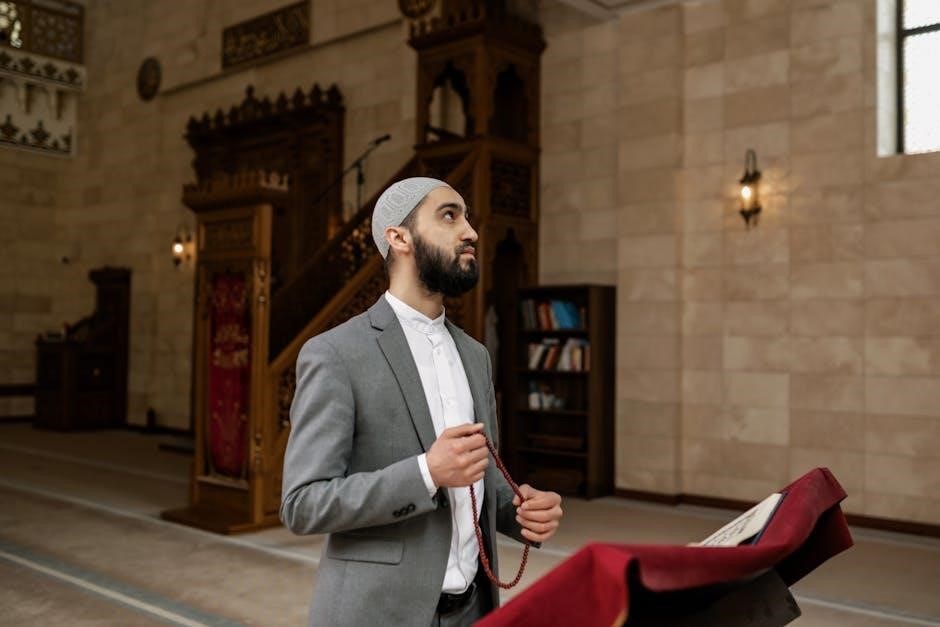
Salah, from “silah” meaning “connection,” is the formal, obligatory prayer of Islam. Performed five times daily, it establishes a direct link with Allah. As the second pillar, it’s considered Islam’s most important matter and a spiritual purification.
Salah as a Direct Connection to Allah
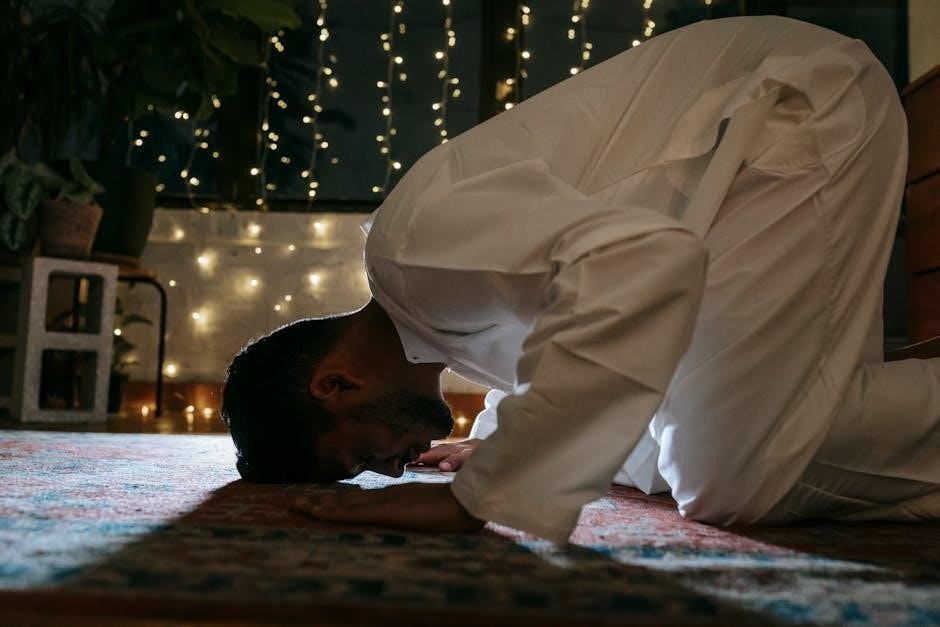
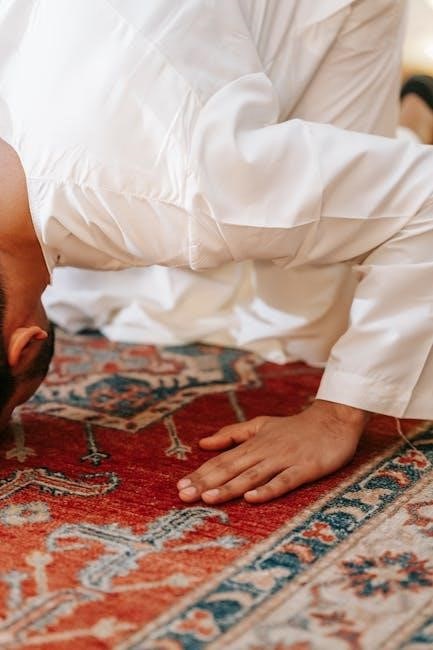
Salah, from “silah” meaning “connection,” establishes a profound link between a believer and Allah. This formal prayer transcends ritual, serving as a direct line of communication, fostering an intimate spiritual bond with the Creator. Through Salah, Muslims engage in personal dialogue with God, expressing gratitude, seeking guidance, and offering supplications. This direct connection is intensely experienced during Sujud, prostration where one places their forehead on the ground. In this posture, believers are closest to Allah, making it a powerful moment for personal Du’a. For beginners, it is comforting that during Sujud, you can make these supplications in English for anything desired – good health, help, guidance, blessings, or to thank God. This heartfelt outpouring strengthens faith and fosters deep closeness. Salah acts as continuous spiritual purification, renewing reliance on divine providence. It is an affirmation of God’s power and an expression of desire for His presence, transforming physical motions into a personal spiritual encounter.
The Obligation of Five Daily Prayers
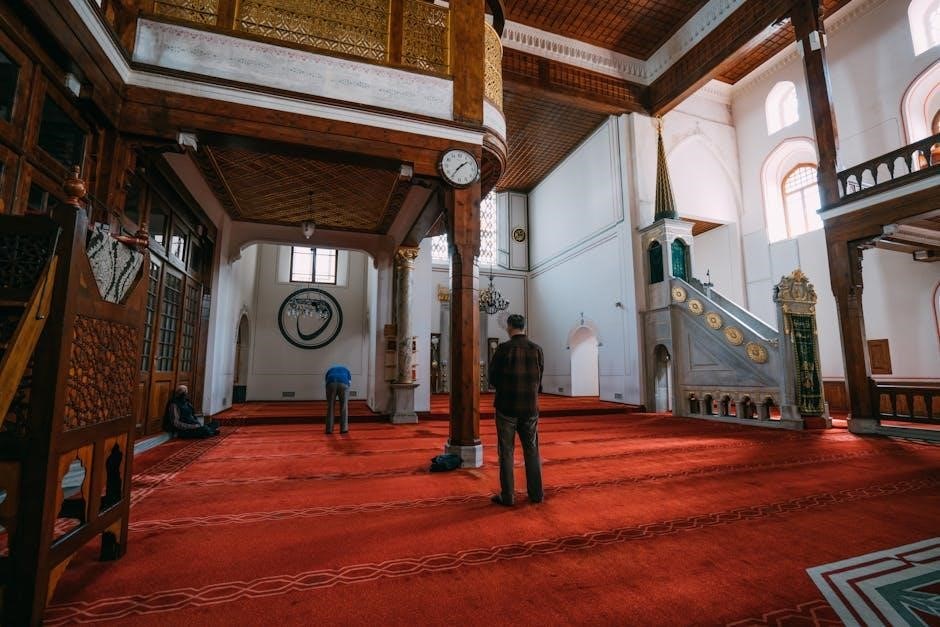
The obligation of performing Salah five times a day is a cornerstone of Islam, marking it as the second pillar of the faith. This formal prayer is a mandatory rite for every obedient adult Muslim, establishing a consistent rhythm of worship throughout the day. Neglecting these prescribed daily ritual devotions means missing a fundamental aspect of one’s spiritual commitment, as they are a direct command from Allah. For beginners, the prospect of integrating five daily prayers might seem daunting, but it’s crucial to embrace this responsibility from the outset. A personal tip for new practitioners is to start praying all five prayers right away, despite potential initial struggles and imperfections. It is natural to make mistakes and experience shortcomings; however, perseverance is absolutely key. The journey begins with consistent effort, even if imperfect, as the intention is what truly matters. While it may initially present a challenge, with dedication and practice, the act of prayer will gradually become easier, more natural, and profoundly fulfilling, InshaAllah (God willing). Utilizing resources like online prayer time calculators, which provide accurate timings based on your exact GPS location, can greatly assist in maintaining this vital daily obligation and ensuring prayers are performed on time, strengthening one’s connection to the divine. This consistent devotion is a powerful form of purification and profound spiritual growth.

Essential Preparations: Prerequisites for Prayer
Before commencing Salah, essential preparations are required. These prerequisites ensure ritual purity and readiness for connecting with Allah. One vital step is performing Wudu (ablution) correctly, which cleanses the body and mind, making you suitable for prayer.
Performing Wudu (Ablution) Correctly
Performing Wudu, the ritual ablution, is an indispensable prerequisite for all Islamic prayers, symbolizing both physical cleanliness and profound spiritual readiness before standing before Allah. To ensure Wudu is performed correctly, always begin with the sincere intention (niyyah) to purify yourself for Salah. The process involves washing specific body parts in a prescribed order, typically three times for most steps. These include the hands, mouth, nose, face, arms up to the elbows, and feet up to the ankles, along with wiping the head and ears once. Adhering to this prescribed sequence and thoroughness is vital for valid Wudu. A properly executed Wudu is a profound act of spiritual purification, laying the foundation for a deeper, more meaningful connection during your prayer. Understanding and practicing its steps precisely is fundamental for every beginner, as incorrect Wudu can invalidate your Salah, making this preparation absolutely paramount for your worship.

Step-by-Step Guide to Performing Salah
This guide provides a clear, step-by-step approach to understanding and performing Islamic prayer, offering practical steps for beginners. It outlines the necessary actions and positions, ensuring you learn Salah correctly and with confidence. This resource walks you through each part of the prayer.
Understanding Basic Actions and Positions (Takbir, Qiyam, Ruku, Sujood)
Understanding the fundamental actions and positions is key to performing Salah correctly. The prayer commences with the Takbir (Takbirat al-Ihram), where you raise your hands to your ears and declare “Allahu Akbar” (God is the Greatest). This sacred declaration marks your entry into prayer, establishing a direct connection with Allah and leaving worldly distractions behind. Following this, you stand in Qiyam, an upright and respectful posture. During Qiyam, essential Quranic recitations, including Surah Al-Fatiha, are performed, fostering concentration and devotion. The next action is Ruku, the bowing position. Here, you bend your upper body forward, resting your hands on your knees, symbolizing humility and glorification. Reciting “Subhana Rabbiyal Azeem” (Glory be to my Lord, the Most Magnificent) repeatedly is crucial in this phase. Finally, Sujood, or prostration, is the most profound act of submission. You place your forehead, nose, palms, knees, and toes on the ground, expressing ultimate reverence. While in Sujood, “Subhana Rabbiyal A’la” (Glory be to my Lord, the Most High) is recited, signifying your closest spiritual proximity to the Creator. Mastering these steps forms the backbone of every unit (rakah) of prayer.
Performing Two Rakaats (Units) for Fajr Prayer
Performing the two units (rakaats) for Fajr prayer is straightforward for beginners. First, make your sincere intention (niyyah) to pray Fajr. Begin by raising your hands to your ears and saying “Allahu Akbar,” marking the start of your prayer and entering a sacred spiritual state. Then, stand in Qiyam, reciting Surah Al-Fatiha, followed by a short chapter from the Quran. Next, bow into Ruku, placing your hands on your knees, and say “Subhana Rabbiyal Azeem” three times. Rise from Ruku, saying “Sami Allahu liman hamidah” and then “Rabbana lakal hamd.” Proceed to Sujood, prostrating with your forehead and nose on the ground, saying “Subhana Rabbiyal A’la” three times. Sit briefly between prostrations, then perform a second Sujood. This completes your first rakaat.
For the second rakaat, stand up again. Repeat the Qiyam, Ruku, and the two Sujoods precisely as you did in the first rakaat. After the second Sujood, sit for Tashahhud, reciting the prescribed supplication. Conclude the prayer by turning your head to the right and then to the left, saying “Assalamu alaykum wa rahmatullah” each time. This comprehensive step-by-step guide enables beginners to perform Fajr confidently.

Recitations in Prayer: Arabic and Transliteration
For beginners, reciting the bare minimum for prayer using English transliteration is acceptable. A printable prayer mat lists these words for ease. You’ll learn meanings over time, but initial focus on recitation is fine.
Reciting the Bare Minimum with English Transliteration
For beginners, it is encouraged to commence prayer immediately once the basic movements are understood. You can perform Salah by reciting the bare minimum phrases using English transliteration. This approach allows establishing a direct connection with Allah without delay. Printable “Web Prayer Mats” are invaluable; they conveniently list all necessary Arabic sayings with transliteration for easy reference during prayers. While memorizing original Arabic verses and comprehending meanings is the ultimate goal, initially it’s perfectly acceptable if you aren’t constantly thinking about each word’s precise significance. Focus on consistent practice and establishing prayer habits. Over time, diligent effort and study will improve Arabic pronunciation; deeper meanings will unfold, strengthening devotion. Beginner-friendly PDF guides and web tutorials include transliterated texts, making learning accessible and less intimidating for every aspiring Muslim. These tools ensure a smooth, confident start to this sacred pillar of Islam, guiding you step-by-step.
The Importance of Memorizing Arabic Verses
The core of Islamic prayer, Salah, mandates recitation in Arabic. This is not merely a linguistic preference but a divine instruction, as Prophet Muhammad (peace be upon him) was taught the prayer by the Angel Jibreel in Arabic, the language chosen by Allah for His final revelation. While beginners can initially utilize English transliteration for the bare minimum verses to establish the habit of prayer, the ultimate objective for every Muslim is to diligently memorize and recite the prayers in their original Arabic form. Learning the Arabic ensures direct adherence to the prophetic tradition and maintains the purity and authenticity of the sacred texts. Many beginner guides and PDF resources, despite offering transliterations, explicitly state that learners must strive to memorize the Arabic versions as a fundamental requirement. This commitment allows for a deeper, more profound spiritual connection, as the original Arabic words carry unparalleled profound meanings and blessings. Understanding the meaning along with accurate Arabic recitation significantly enhances the spiritual experience, fostering a more conscious, intimate, and meaningful dialogue with Allah. It’s a journey of continuous learning, transforming initial reliance on transliteration into heartfelt and accurate Arabic recitation, reinforcing the integral, sacred role of Arabic in connecting with our Creator.
Making Du’a in English During Sujud
During the prostration (Sujud) in Salah, a truly unique and deeply personal moment arises where a worshipper is closest to Allah. This profound position, with the forehead touching the ground, symbolizes ultimate humility and submission, making it a time when supplications (Du’a) are most likely to be accepted. For beginners, and indeed for all Muslims, it is permissible and highly encouraged to make personal Du’a in any language, including English, during Sujud. While the formal recitations of Salah must be in Arabic, this specific moment offers a precious window for heartfelt, direct communication with the Creator in one’s native tongue. You can express anything that is in your heart – pray for good health for yourself and loved ones, seek help with difficulties, ask for guidance in your affairs, or request more blessings in your life. Critically, it is also an excellent opportunity to offer sincere gratitude to Allah for all the favors and blessings He has bestowed upon you. This flexibility allows new Muslims to connect deeply and personally with God without the immediate barrier of Arabic memorization for personal prayers, fostering a strong spiritual bond from the very beginning of their prayer journey. This practice helps solidify faith, makes the prayer experience more meaningful and intimate, and reinforces the idea of God’s accessibility and mercy.
Key Resources for Learning and Practicing Salah
Discover essential resources for learning Salah. Download beginner-friendly PDF guides, booklets, and utilize web tutorials with videos for step-by-step instructions on performing prayers. Interactive guides, prayer mats, and mosque finders are invaluable tools for new practitioners.
Downloading Beginner-Friendly PDF Guides and Booklets
Embarking on the journey to learn Islamic prayer is significantly aided by readily available beginner-friendly PDF guides and booklets. These downloadable resources are meticulously designed to provide clear, step-by-step instructions, making the intricate process of Salah accessible for new practitioners. Many guides feature detailed explanations complemented by helpful diagrams, simplifying the various positions and actions required during prayer. They often include translations of essential Arabic phrases, enabling learners to understand the profound meaning behind their recitations. Furthermore, these comprehensive booklets are not solely for new Muslims; parents frequently employ them as effective tools to teach their children how to pray accurately. Emphasizing simplicity, these guides concentrate on the fundamental aspects of Salah, ensuring a smooth and encouraging learning curve for novices. Resources such as the “LEARN TO PRAY (SALAH) Web Prayer Booklet” offer concise explanations of prerequisites and actions. You can find free, easy-to-follow PDF guides specifically tailored for beginners, providing a thorough breakdown of each prayer component. These documents often detail the precise number of units (rakaats) for each of the five daily prayers, offering a structured approach to mastering Salah. Such downloadable materials serve as invaluable companions, empowering learners to progress at their own pace and cultivate confidence in their worship.
Utilizing Web-Based Tutorials and Video Guides
Harnessing the power of web-based tutorials and video guides provides an incredibly effective and visual approach for beginners learning Islamic prayer. These dynamic resources offer step-by-step demonstrations, which are invaluable for understanding the correct actions and positions of Salah, such as Takbir, Qiyam, Ruku, and Sujood. Many video guides explicitly explain the necessary steps for prayer, including detailed demonstrations of how to perform all five mandatory prayers. Interactive web tutorials, like “How Do I Pray?”, walk users through the entire prayer sequence, often including English transliteration for Arabic recitations, making it easier to follow along. Specific videos, such as those illustrating “How to pray 2 Rakat (units) for Fajr Prayer,” break down individual prayers into easily digestible segments. Furthermore, valuable web resources extend beyond direct prayer instruction to include practical tools like “Web Prayer Times” for accurate local prayer schedules and “Mosque-Finder” to locate nearby mosques. These online platforms and video channels create a rich, accessible learning environment, empowering new Muslims to practice and refine their prayer with confidence and clarity.

Tips for a Successful Beginner’s Prayer Journey
Embarking on your prayer journey is a blessed step. A crucial tip for beginners is to start praying as soon as you grasp the basics. Don’t delay perfection; consistency is key. It’s perfectly acceptable to recite the bare minimum needed for prayer, using English transliteration if necessary, perhaps from a printed prayer mat. While understanding the meaning is important long-term, for now, simply focusing on the recitation is sufficient. God willing, comprehension will grow with practice. A powerful accelerator for learning is to pray with other Muslims; allow experienced individuals to lead you, fostering a sense of community and correct practice. A personal recommendation is to begin all five daily prayers immediately. Expect to make mistakes and experience shortcomings; this is a natural part of the learning process. The key is perseverance and continuous effort daily. Initially, it will be challenging, but with dedication, it will become progressively easier, InshaAllah. Remember, during Sujood (prostration), you are closest to Allah, and you can make personal supplications (Du’a) in English. Focus on the order, what you say, and performing prayers on time. Don’t be discouraged by slight variations in prayer styles; the core elements remain consistent. Welcome to this rewarding path!